





blog
What Is the Best Fuel for a Tunnel Oven?

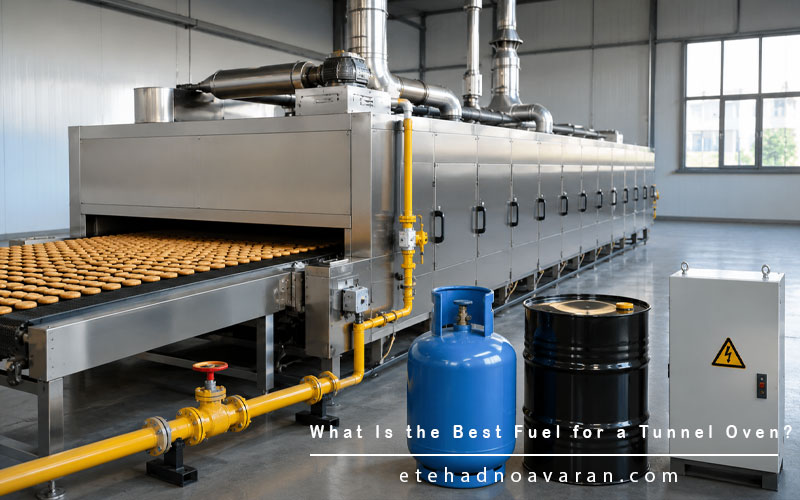
In the food manufacturing industry, baking quality plays a vital role in the success of the final product. Biscuits, crackers, cookies, and many similar products can only achieve the desired quality when the baking process is uniform, precise, and fully controllable. For this reason, the tunnel oven is considered one of the most important pieces of equipment in industrial production lines.
What Is the Best Fuel for a Tunnel Oven?
Choosing the right fuel is not limited to energy costs alone. Factors such as thermal efficiency, baking quality, maintenance costs, fuel availability, production capacity, and even regional climate conditions all play an important role in this decision.
What Is a Tunnel Oven?
A tunnel oven is an industrial baking system in which products continuously move through the oven on a conveyor belt while baking takes place across multiple heating zones. Unlike traditional batch ovens, tunnel ovens operate continuously, allowing for significantly higher production capacity while maintaining consistent product quality throughout the process.
Tunnel ovens are commonly used to produce:
- Biscuits
- Crackers
- Wafers
- Cookies
- Industrial bread
- Cakes
- Snacks
- Dry pastries
Why Is Fuel Selection Important?
The type of fuel directly affects:
- Production cost per kilogram of product
- Time required to reach operating temperature
- Baking consistency
- Product color quality
- Energy consumption
- Maintenance costs
- Equipment lifespan
- Environmental emissions
Choosing the wrong fuel can significantly increase production costs.
Types of Fuel Used in Tunnel Ovens
Three primary fuel sources are used in tunnel ovens:
- Natural gas
- Diesel fuel
- Electricity
Some manufacturers also design dual-fuel tunnel ovens that can operate on both natural gas and diesel as alternative fuel sources.
Natural Gas Tunnel Oven
In Iran, natural gas tunnel ovens are the most popular choice for biscuit manufacturing plants. Natural gas offers lower operating costs, cleaner combustion than diesel, and reduced equipment maintenance expenses.
Advantages
- Lowest fuel cost
- High thermal efficiency
- Uniform flame distribution
- Precise temperature control
- Lower production costs
- Reduced emissions
- Suitable for 24-hour continuous production
Disadvantages
- Requires an industrial gas connection
- Dependent on gas network pressure
- Possible seasonal gas supply restrictions
Diesel-Fired Tunnel Oven
In areas without access to natural gas, diesel is considered the best alternative. These ovens typically use powerful industrial burners capable of delivering high thermal output.
Advantages
- Suitable for all locations
- Rapid heating
- Ideal for factories far from gas networks
Disadvantages
- Higher fuel costs
- Requires fuel storage tanks
- Burner requires periodic maintenance
- Higher emissions
Electric Tunnel Oven
Some food industries use electric heating elements to generate heat. These ovens are generally used for smaller production capacities or in countries where industrial electricity costs are relatively low.
Advantages
- No smoke
- No burner required
- Highly precise temperature control
- Lower maintenance requirements
Disadvantages
- High electricity consumption
- Higher energy costs
- Requires high-capacity three-phase electrical power
Comparison of Tunnel Oven Fuel Types
| Feature | Natural Gas | Diesel | Electricity |
|---|---|---|---|
| Energy Cost | ⭐⭐⭐⭐⭐ | ⭐⭐⭐ | ⭐⭐ |
| Baking Quality | ⭐⭐⭐⭐⭐ | ⭐⭐⭐⭐ | ⭐⭐⭐⭐⭐ |
| Maintenance Cost | ⭐⭐⭐⭐ | ⭐⭐⭐ | ⭐⭐⭐⭐⭐ |
| Emissions | Low | High | Very Low |
| Suitable for Mass Production | Yes | Yes | Limited |
Which Fuel Is Best for Biscuit Production؟
If the factory has access to municipal or industrial natural gas, a gas-fired tunnel oven is the best option because it offers:
- Lower operating costs
- Better baking quality
- Higher efficiency
- More precise temperature control
- Faster return on investment
Does Fuel Type Affect Biscuit Quality?
Yes, but not as much as many people assume. Product quality depends primarily on:
- Hot air circulation design
- Number of heating zones
- Temperature control system
- Uniform heat transfer
- Conveyor belt speed
If these factors are properly designed, the quality difference between gas-fired and diesel-fired ovens is minimal.
Heating Zone System in Tunnel Ovens
Professional tunnel ovens usually include multiple heating zones.
Zone 1
Initial moisture evaporation
Approximate temperature:
150–180°C
Zone 2
Primary baking
Approximate temperature:
200–230°C
Zone 3
Color development
Approximate temperature:
180–210°C
Zone 4
Final drying
Approximate temperature:
150–180°C
This zoning system ensures uniform baking throughout the product.
What Affects Tunnel Oven Fuel Consumption?
Many people assume all tunnel ovens consume the same amount of energy. In reality, fuel consumption depends on:
- Oven length
- Oven width
- Insulation thickness
- Burner quality
- Production capacity
- Ambient temperature
- Conveyor speed
- Product type
How Can Fuel Consumption Be Reduced?
Energy consumption can be minimized by:
- Using high-efficiency burners
- Installing proper insulation
- Correct burner adjustment
- Regular burner maintenance
- Intelligent temperature control
- Preventing heat loss
- Using heat recovery systems
What Is a Dual-Fuel Tunnel Oven?
Some factories prefer tunnel ovens that can operate with both natural gas and diesel fuel.
Advantages include:
- Prevents production downtime
- Greater operational flexibility
- Ideal for emergency situations
- Improved production reliability
What Should You Consider When Buying a Tunnel Oven?
Many buyers focus only on the purchase price, while the following factors are even more important:
- Stainless steel body quality
- Insulation thickness
- Burner brand
- PLC control system
- Number of heating zones
- Temperature uniformity
- Energy efficiency
- After-sales service
- Spare parts availability
- Manufacturer experience
About Etehad Novavaran
Etehad Novavaran is a specialized Iranian manufacturer of industrial food processing equipment with years of experience in designing, manufacturing, and commissioning food production lines. By combining technical expertise, high-quality components, and modern technologies, the company designs and manufactures a wide range of equipment for biscuit, cookie, cracker, cake, and other food production lines.
Its product portfolio includes industrial tunnel ovens, dough mixers, forming machines, conveying systems, cooling equipment, and packaging machines, all custom-designed according to each factory’s production requirements.
The company’s mission is to provide high-efficiency industrial solutions with optimized energy consumption and reliable after-sales service, enabling manufacturers to confidently expand their production capacity.
Why Choose Etehad Novavaran?
✔ Custom design and manufacturing based on factory production capacity
✔ High-quality industrial materials and components
✔ Optimized energy consumption and high efficiency
✔ Installation and commissioning by experienced specialists
✔ Operator training after installation
✔ Reliable after-sales service and spare parts supply
✔ Free consultation for food production line projects
✔ Extensive experience in projects across Iran
Etehad Novavaran Services
We provide comprehensive solutions for establishing and expanding food production lines, including:
- Biscuit production line design and manufacturing
- Cookie production line design and manufacturing
- Cracker production line design and manufacturing
- Industrial tunnel oven manufacturing
- Industrial mixer manufacturing
- Material handling system design
- Packaging equipment manufacturing
- Production line modernization and optimization
- Spare parts supply, maintenance, and repair services
- Factory setup consultation and production capacity expansion
Purchasing Tunnel Ovens and Production Line Equipment
If you are planning to establish a biscuit manufacturing plant or expand your production line, Etehad Novavaran’s specialists are ready to evaluate your requirements and recommend the most suitable equipment. Every machine is designed and manufactured according to production capacity, factory layout, and product type to ensure maximum efficiency and minimum energy consumption.
Contact Us
For free consultation, price inquiries, and equipment orders for the food industry, contact Etehad Novavaran through our website or social media channels.
Website:
etehadnoavaran.com
If your website includes contact information, phone numbers, email addresses, or your company address, you may also add them in this section to make it easier for customers to reach you.
Social Media
Follow Etehad Novavaran’s official social media pages to view completed projects, production line videos, machine demonstrations, and the latest educational content.
- Telegram
- Rubika
Request a Free Consultation
Selecting the right equipment is the most important step toward building a successful production line. If you have any questions about choosing a tunnel oven, designing a biscuit production line, or selecting other food processing machinery, Etehad Novavaran’s experts are ready to provide free professional consultation.
Contact us today and benefit from expert guidance for establishing or expanding your production line.
Conclusion
Choosing the best fuel for a tunnel oven depends on factors such as production capacity, energy availability, operating costs, and product type. However, for most biscuit and cookie manufacturers in Iran, natural gas-fired tunnel ovens are the preferred solution due to their lower operating costs, higher efficiency, and excellent baking performance. In regions with limited gas access, diesel-fired or dual-fuel tunnel ovens provide a practical solution for maintaining uninterrupted production.
With extensive experience in designing and manufacturing food processing equipment and biscuit production lines, Etehad Novavaran designs and manufactures tunnel ovens tailored to each factory’s specific requirements. The company offers gas-fired, diesel-fired, and custom-built tunnel ovens using high-quality industrial components and advanced control systems, along with installation, commissioning, and technical support services.
Frequently Asked Questions
What is the best fuel for a tunnel oven?
If natural gas is available, a gas-fired tunnel oven is the best choice.
Is an electric tunnel oven better?
It offers extremely precise temperature control, but energy costs are generally higher for large-scale production.
Does a diesel-fired tunnel oven produce lower-quality products?
No. If the burner and heat transfer system are properly designed, baking quality can be excellent.
Can a diesel-fired tunnel oven be converted to natural gas?
Yes. In many models, replacing the burner and making certain technical modifications allows conversion to natural gas. This work should always be performed by the manufacturer or qualified specialists.
Why is choosing the right tunnel oven manufacturer important?
Even the best fuel cannot compensate for poor oven design. Factors such as manufacturing quality, insulation, airflow design, control system accuracy, and after-sales service have a direct impact on oven efficiency and lifespan.