





blog
Solutions to increase the efficiency of the biscuit production line

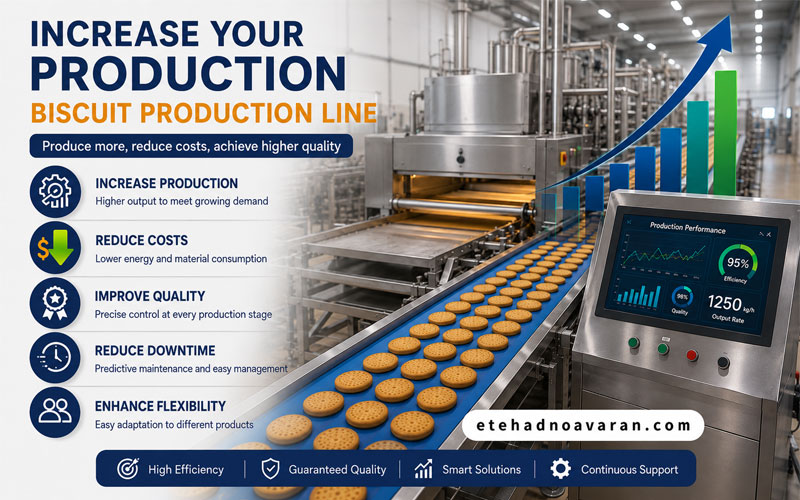
In the food manufacturing industry, increasing the efficiency of a biscuit production line is one of the most important factors behind a factory’s success. Today, competition is no longer based solely on product quality. The most successful manufacturers are those that can deliver high-quality, consistent products while minimizing energy consumption, reducing waste, and maximizing production speed.
Many factory managers believe that increasing production capacity is only possible by purchasing new machinery. In reality, however, optimizing production processes, implementing proper machine maintenance, training employees, and making effective use of existing equipment can significantly improve production line efficiency.
In this article, we examine the most effective strategies for improving biscuit production line productivity and explain how manufacturers can reduce costs, improve product quality, and increase profitability.
Why Is Increasing Biscuit Production Line Efficiency Important?
Higher efficiency means producing more with fewer resources. This not only lowers manufacturing costs but also improves product quality, speeds up order fulfillment, and increases customer satisfaction.
Benefits of Higher Production Efficiency
- Lower production cost per unit
- Reduced raw material waste
- Increased production capacity
- Improved biscuit quality
- Lower energy consumption
- Longer equipment lifespan
- Higher factory profitability
- Stronger competitiveness in domestic and export markets
Factors Affecting Biscuit Production Line Efficiency
Before implementing any improvement program, it is essential to identify the factors that influence production line performance. The most important factors include:
- Raw material quality
- Production line design
- Machinery performance
- Operator skills
- Production planning
- Quality control
- Maintenance and repairs
- Energy consumption
- Equipment automation
- Raw material inventory management
1. Using Modern and Standard Machinery
One of the most important ways to improve productivity is by using modern, standardized equipment. Older machines often consume more energy, experience frequent breakdowns, and provide lower production accuracy.
Modern equipment, equipped with advanced technologies, can:
- Increase production speed
- Ensure consistent product quality
- Reduce production waste
- Optimize energy consumption
- Lower maintenance costs
2. Choosing High-Quality Raw Materials
The quality of raw materials directly affects production line performance. Flour, sugar, oil, flavorings, and other ingredients should always be sourced from reliable suppliers.
Poor-quality raw materials may lead to:
- Changes in dough consistency
- Increased waste
- Poor baking quality
- Frequent production stoppages
- Higher rates of defective products
3. Optimizing Dough Formulation
A well-designed dough formulation not only improves product quality but also enhances machine performance.
A standard dough formulation provides:
- More uniform dough consistency
- Better molding performance
- More even baking
- Reduced product breakage
- Optimized raw material consumption
4. Proper Production Planning
One of the main reasons for reduced factory efficiency is poor production planning.
An effective production plan should include:
- Order scheduling
- Daily production plans
- Raw material supply
- Maintenance schedules
- Workforce management
Proper planning reduces downtime and improves equipment utilization.
5. Implementing Preventive Maintenance (PM)
Many factories repair machinery only after a failure occurs. This reactive approach results in unexpected downtime and increased operating costs.
A preventive maintenance program includes:
- Regular equipment inspections
- Lubrication of moving parts
- Inspection of motors and gearboxes
- Checking belts and chains
- Equipment calibration
- Replacing wear parts before failure
Implementing preventive maintenance reduces breakdowns while extending equipment lifespan.
6. Continuous Operator Training
Even the most advanced machinery cannot achieve optimal performance without properly trained operators.
Training employees in machine operation, adjustment, and maintenance reduces human error and improves productivity. Skilled operators can identify problems more quickly and prevent unnecessary production interruptions.
7. Reducing Energy Consumption in Biscuit Production Lines
Electricity and natural gas are among the largest operating costs in biscuit manufacturing plants. While many factory managers focus primarily on increasing production, reducing energy consumption can significantly improve net profitability.
The following measures can help reduce energy consumption:
- Using high-efficiency tunnel ovens
- Proper insulation of thermal equipment
- Using high-efficiency electric motors
- Turning off idle equipment
- Intelligent oven temperature control
- Regular maintenance of burners and heating systems
- Installing variable frequency drives (VFDs) on electric motors
Optimizing energy consumption not only lowers production costs but also contributes to environmental sustainability.
8. Using Industrial Automation Systems
Modern factories increasingly rely on PLC systems, HMI interfaces, and smart sensors to control production processes.
The advantages of automation include:
- Reduced human error
- Precise control of baking temperature and time
- Increased production speed
- Automatic production data recording
- Reduced production line downtime
- Improved product quality
Automation systems also make it possible to analyze production performance and identify operational bottlenecks.
9. Quality Control Throughout the Production Process
Quality control should not be limited to the finished product. In a professional production line, quality should be monitored from raw material receiving to final packaging.
Raw Materials
- Flour quality
- Moisture content
- Oil quality
- Safety and quality of additives
Dough
- Dough temperature
- Mixing time
- Moisture level
- Dough consistency
Baking
- Oven temperature
- Baking time
- Product color
- Final moisture content
Packaging
- Package integrity
- Product weight
- Production and expiration date printing
A comprehensive quality control system reduces waste and increases customer satisfaction.
10. Reducing Raw Material Waste
Material waste is one of the primary factors affecting factory profitability.
The main causes of waste include:
- Improper mold adjustment
- Poor dough formulation
- Conveyor system failures
- Incorrect tunnel oven settings
- Poor packaging quality
Waste can be minimized by:
- Regular equipment calibration
- Employee training
- Accurate raw material weighing
- Using modern machinery
- Recording and analyzing the causes of waste
11. Proper Production Line Layout Design
Equipment layout plays a significant role in improving production efficiency.
If machines are positioned too far apart or raw material flow is poorly designed, production time increases and overall efficiency decreases.
An effective production layout should provide:
- Minimum material handling
- Easy access for maintenance
- Compliance with safety standards
- Flexibility for future expansion
- Reduced interference between operators
12. Raw Material Inventory Management
Both raw material shortages and excessive inventory can create operational problems.
Proper inventory management helps:
- Reduce production interruptions
- Improve working capital management
- Ensure raw materials are used before expiration
- Lower storage costs
Warehouse management software can greatly improve inventory control.
13. Production Data Analysis
Collecting and analyzing production data enables managers to identify problems quickly and make informed decisions.
Key production data include:
- Daily production capacity
- Waste percentage
- Equipment downtime
- Energy consumption
- Product quality
- Performance of each machine
Analyzing this information allows manufacturers to continuously improve production line performance.
14. Measuring Overall Equipment Effectiveness (OEE)
One of the most important production performance indicators is Overall Equipment Effectiveness (OEE).
OEE measures three key factors:
- Availability: How long was the equipment available for production?
- Performance: Did the equipment operate at its standard production speed?
- Quality: What percentage of products were manufactured without defects?
Continuous OEE monitoring helps identify production bottlenecks and improve equipment efficiency.
15. Choosing a Reliable Machinery Manufacturer: An Investment for the Future
One factor that is often overlooked is the selection of the machinery manufacturer. Machine build quality, engineering design, after-sales service, and spare parts availability all have a direct impact on production line efficiency.
A professional machinery manufacturer should be able to:
- Design a production line according to the factory’s specific requirements
- Supply high-efficiency machinery with optimized energy consumption
- Provide installation, commissioning, and operator training
- Deliver spare parts in the shortest possible time
- Offer professional technical support and engineering consultation
Choosing a reliable industrial partner can prevent many operational problems and ensure long-term production stability.
Biscuit Production Line Efficiency Checklist
If you want to improve your factory’s performance, regularly review the following items:
✅ Use high-quality raw materials
✅ Perform routine machinery maintenance
✅ Implement a preventive maintenance (PM) program
✅ Apply quality control throughout every stage of production
✅ Optimize energy consumption
✅ Continuously train machine operators
✅ Utilize automated equipment
✅ Reduce raw material waste
✅ Monitor OEE performance
✅ Analyze production data
✅ Improve production line layout
✅ Properly manage raw material inventory
✅ Develop accurate production schedules
✅ Work with a reputable machinery manufacturer
The Future of Biscuit Production Lines: Moving Toward Smart Factories
The food processing machinery industry is evolving rapidly. Today, leading manufacturers use technologies such as the Internet of Things (IoT), Artificial Intelligence (AI), real-time monitoring systems, and production data analytics to optimize manufacturing processes.
In the coming years, the most successful production lines will be those capable of:
- Reducing energy consumption
- Minimizing production waste
- Maintaining consistent product quality
- Intelligently controlling production processes
- Recording and analyzing production data for accurate decision-making
Investing in advanced technologies, employee training, and standardized machinery will become one of the most important factors for maintaining competitiveness in the global market.
Conclusion
Improving biscuit production line efficiency is not limited to purchasing new machinery. It requires a comprehensive approach that includes selecting the right equipment, implementing preventive maintenance, training employees, maintaining strict quality control, optimizing energy management, and analyzing production data.
When these strategies are consistently implemented, manufacturers can significantly reduce production costs, improve product quality, increase order fulfillment speed, and maximize profitability.
In today’s highly competitive market, the most successful factories are those that continuously optimize their production processes through scientific methods and data-driven decision-making.
Frequently Asked Questions
What is the most important factor in improving biscuit production line efficiency?
The greatest improvement comes from combining standardized machinery, preventive maintenance programs, comprehensive quality control, and continuous operator training.
How can production line waste be reduced?
Waste can be minimized by using high-quality raw materials, accurately adjusting machinery, carefully monitoring production processes, and performing regular equipment maintenance.
Does automation improve productivity?
Yes. Automated systems reduce human error, improve product consistency, increase production speed, and enhance overall manufacturing efficiency.
Why is preventive maintenance important?
Preventive maintenance prevents unexpected equipment failures, extends machinery lifespan, reduces emergency repair costs, and minimizes production downtime.
How does OEE help a factory?
Overall Equipment Effectiveness (OEE) measures equipment performance based on availability, performance, and quality. It helps manufacturers identify production bottlenecks, improve equipment utilization, and increase overall production efficiency.