





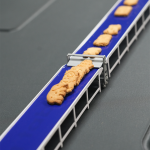
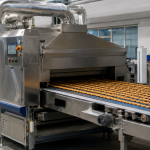
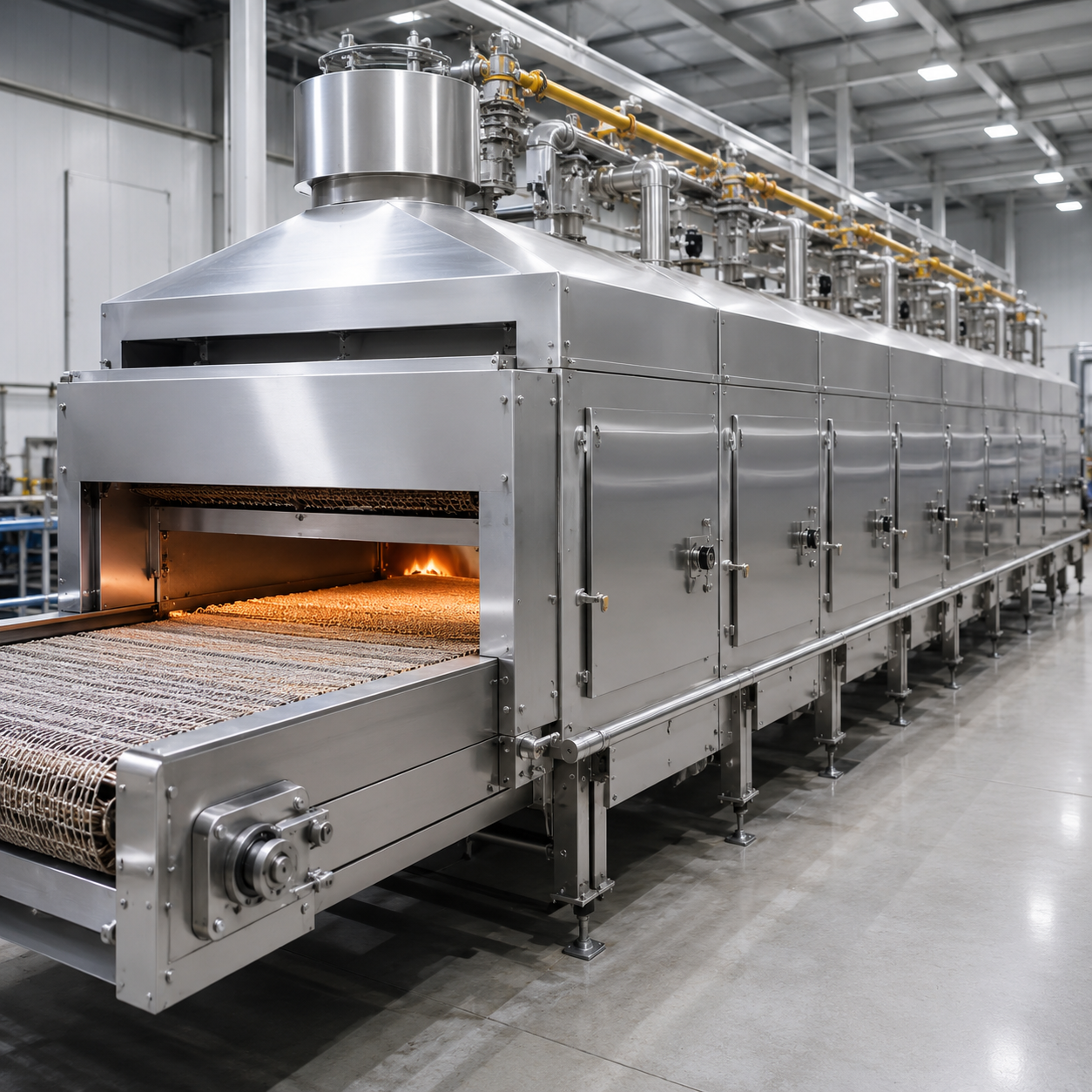
Direct Fired Tunnel Oven
پخت یکنواخت انواع بیسکویت، کراکر و کوکی
راندمان حرارتی بالا و مصرف انرژی بهینه
کنترل مستقل دمای هر زون با سیستم PLC
طراحی سفارشی متناسب با ظرفیت خط تولید
استفاده از استیل ضدزنگ گرید غذایی (AISI 304/316)
قابلیت ساخت در طولهای ۲۰ تا ۶۰ متر
مجهز به مشعلهای صنعتی کممصرف
امکان تنظیم سرعت نوار نقاله و زمان پخت
کاهش ضایعات و افزایش کیفیت محصول
نصب، راهاندازی و خدمات پس از فروش توسط اتحاد نوآوران
All products are delivered in coordination with the customer.
جهت راهنمایی درباره خرید انواع خط تولید با مشاوران ما تماس بگیرید.
Product De
| کشور سازنده | ایران |
|---|---|
| برند | اتحاد نوآوران نوروززاده |
| طول فر | ۲۰ تا ۶۰ متر (قابل سفارشیسازی) |
| نوع فر | تونلی حرارت مستقیم |
| جنس بدنه | استیل ضدزنگ AISI 304 |
| جنس نوار نقاله | توری فولادی نسوز یا مش استیل مقاوم در برابر حرارت |
| توان مصرفی | حدود ۱۰ تا ۲۵ کیلووات |
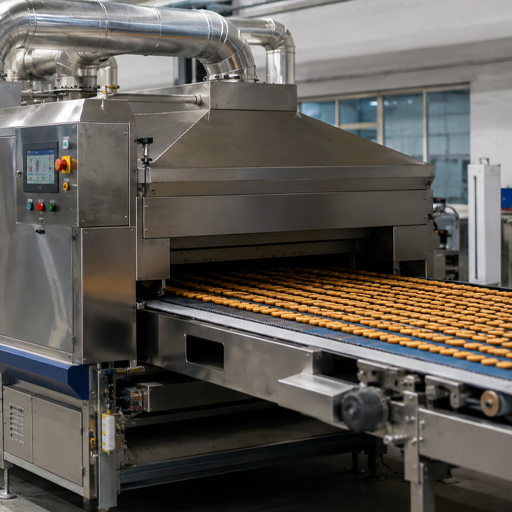
Direct Fired Tunnel Oven for Biscuit Production Line
In the modern biscuit production industry, baking quality is one of the most important factors determining the success of a product in the market. Even if the dough is prepared with the highest quality ingredients and the forming process is performed with the most precise equipment, improper baking system performance can negatively affect the final product in terms of color, texture, taste, and shelf life.
For this reason, the Direct Fired Tunnel Oven for Biscuit Production Line is considered one of the most important and sensitive pieces of equipment in the production line and plays a decisive role in achieving final product quality.
The Direct Fired Tunnel Oven transfers thermal energy directly from burners into the baking chamber, providing ideal conditions for uniform baking of various biscuits, crackers, cookies, and other flour-based products. Due to its high heat transfer speed, suitable efficiency, precise temperature control, and reduced baking time, this type of oven is one of the most widely used thermal systems in biscuit manufacturing factories.
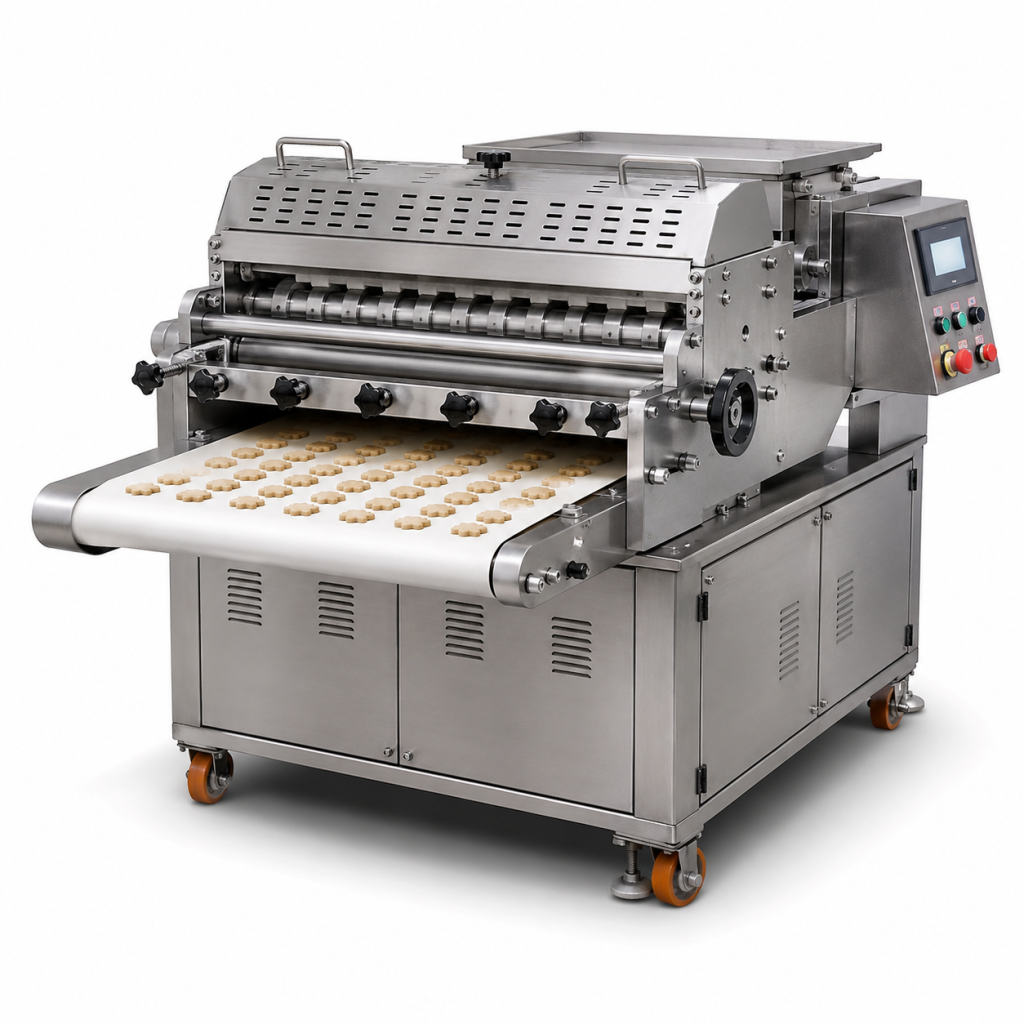
In this system, biscuits enter the tunnel oven on a heat-resistant conveyor belt after passing through the molding machine or cutter. They then move through several heating zones with different temperatures. Each zone performs a specific function, including dough structure stabilization, moisture evaporation, golden color formation, crispy texture development, and completion of the baking process.
This multi-zone design ensures that all products leave the oven with consistent quality and without burning or under-baking.
Direct Fired Tunnel Oven in Biscuit Production Line
One of the most important advantages of a direct fired tunnel oven is the ability to adjust the temperature of each zone independently. This feature allows manufacturers to define a suitable baking profile for each product type and produce different kinds of biscuits with consistent quality without major changes to the equipment.
In addition, the use of intelligent control systems, PLC, HMI touch screens, and accurate temperature sensors makes oven management easier, reduces energy consumption, and increases production line efficiency.
Ettehad Novavaran Company, with years of experience in designing and manufacturing food industry machinery, designs and produces various types of direct fired tunnel ovens according to production capacity, factory space, and product type.
These ovens are manufactured using stainless steel, high-quality thermal insulation materials, standard burners, and advanced control systems to provide the highest baking quality while reducing energy costs.
In this article, you will learn about the operating principle, main components, advantages, technical specifications, types of direct fired tunnel ovens, factors affecting price, important purchasing points, and technical features of this equipment to make the best choice for your biscuit production line.
How Does a Direct Fired Tunnel Oven Work in a Biscuit Production Line?
In a direct fired tunnel oven, biscuits shaped by the molding machine or cutter enter the baking chamber on a heat-resistant conveyor belt.
Gas burners installed in different sections of the oven transfer heat directly into the baking chamber, and the products move through several heating zones with adjustable temperatures.
In each zone, a specific stage of the baking process is performed, including dough structure stabilization, moisture evaporation, golden color development, and crispy texture formation.
At the end of the process, baked biscuits leave the oven with uniform quality and are ready to enter the cooling conveyor and then the packaging stage.
Direct Fired Tunnel Oven or Indirect Fired Tunnel Oven: Which One Is Better?
Choosing between a direct fired tunnel oven and an indirect fired tunnel oven depends on the product type, production capacity, required quality level, and factory budget.
Each system has its own advantages and applications and is used for different products in the food industry.
What Are the Advantages of a Direct Fired Tunnel Oven?
This type of oven has a higher baking speed due to direct heat transfer and also provides optimized fuel consumption.
For this reason, it is considered one of the most common choices for biscuit, cracker, and similar product production lines.
In addition, the purchase and maintenance costs of direct fired tunnel ovens are generally lower compared to indirect fired models.
When Is an Indirect Fired Tunnel Oven More Suitable?
If the produced product requires extremely precise temperature control, prevention of direct contact with combustion gases, or completely uniform baking conditions, an indirect fired tunnel oven can be a more suitable option.
This type of oven is mainly used for certain special food products that require strict control over the baking environment.
Which Oven Is Better for a Biscuit Production Line?
For most biscuit production lines, especially medium and high-capacity production facilities, the direct fired tunnel oven is considered an ideal choice due to:
- High baking speed.
- Excellent thermal efficiency.
- Lower energy consumption.
- Economical operating costs.
However, selecting the best oven type should ultimately be based on the biscuit type, production capacity, and factory conditions.
Ettehad Novavaran designs and manufactures suitable tunnel ovens by analyzing the requirements of each production unit to achieve the highest baking quality and production efficiency.
Technical Features of Direct Fired Tunnel Oven
- Ability to design and manufacture in different lengths according to production capacity.
- Uniform baking of various biscuits and crackers.
- Independent temperature control of each zone to improve product quality.
- Reduced fuel consumption through the use of standard thermal insulation.
- Fully stainless-steel body resistant to corrosion and moisture.
- Use of high-efficiency industrial burners.
- Heat-resistant conveyor belt with long service life.
- Smart PLC and HMI control system.
- Adjustable conveyor speed according to baking time.
- Easy maintenance and servicing.
- Designed according to food industry standards (Food Grade).
- Capability of connection to production line automation systems.
- Possibility of customization of dimensions, capacity, and fuel type according to customer requirements.
Types of Direct Fired Tunnel Ovens
Direct fired tunnel ovens are designed and manufactured in different models based on production capacity, product type, energy source, and heating system structure.
Selecting the right model has a direct impact on baking quality, energy consumption, production speed, and overall production line efficiency.
Below are the most common types of direct fired tunnel ovens:
-
Gas Direct Fired Tunnel Oven
The most common type of tunnel oven in biscuit manufacturing industries is the gas tunnel oven.
In this model, gas burners transfer heat directly into the baking chamber. Due to high efficiency, optimized fuel consumption, and suitable operating costs, these ovens are an ideal choice for medium and high-capacity factories.
Advantages:
- Economical fuel consumption.
- High heat transfer speed.
- Uniform baking.
- Suitable for mass production.
-
Direct Fired Tunnel Oven Using LPG Fuel
In areas where natural gas is not available, tunnel ovens equipped with LPG (Liquefied Petroleum Gas) burners are used.
This model operates similarly to a gas-fired oven, with the main difference being the type of fuel used.
Applications:
- Factories outside the natural gas network.
- Production units located in industrial zones.
-
Multi-Zone Tunnel Oven
This model includes several independent heating zones where the temperature of each section can be controlled separately.
Modern tunnel ovens usually have between 3 and 8 heating zones.
Advantages:
- Precise control of different baking stages.
- Uniform product quality.
- Reduction of production waste.
- Suitable for various types of biscuits and crackers.
-
Direct Fired Tunnel Oven with Metal Mesh Conveyor
In this model, products are transferred through the oven using a heat-resistant metal mesh conveyor belt.
This type of conveyor allows better hot air circulation and provides more uniform biscuit baking.
Applications:
- Hard biscuits.
- Crackers.
- Products with longer baking times.
-
Tunnel Oven with Smart PLC Control
This model is equipped with a PLC control system and HMI touch screen, allowing precise adjustment of:
- Temperature.
- Conveyor speed.
- Baking time.
- Burner operation.
Advantages:
- Reduction of human errors.
- Increased process control accuracy.
- Production data recording.
- Reduced energy consumption.
-
Customized Tunnel Oven
Some factories require customized ovens due to limited space or specific production capacity requirements.
In this model, the oven length, conveyor width, number of heating zones, burner type, control system, and other technical specifications are designed according to customer needs.
Advantages:
- Design according to factory space.
- Possibility of increasing production capacity.
- Full compatibility with other production line equipment.
Which Type of Direct Fired Tunnel Oven Is More Suitable?
Choosing the best type of tunnel oven depends on factors such as:
- Production capacity.
- Biscuit type.
- Factory space.
- Fuel source.
- Available budget.
For most biscuit production lines, a multi-zone gas tunnel oven equipped with a PLC control system is considered the best option because it provides:
- Uniform baking.
- Optimized energy consumption.
- Precise temperature adjustment.
- Ability to produce different types of biscuits.
Ettehad Novavaran designs and manufactures various direct fired tunnel ovens with different dimensions and capacities. By providing specialized consultation, the company recommends the most suitable model according to each factory’s requirements.
For more information, price inquiry, and custom manufacturing orders, you can contact our experts through WhatsApp, Telegram, and Rubika or visit:
etehadnoavaran.com
Direct Fired Tunnel Oven Price and Factors Affecting Manufacturing Cost
The price of a direct fired tunnel oven for a biscuit production line does not have a fixed value due to its customized design, production capacity, and the equipment used.
Each oven is designed and manufactured according to the product type, production line dimensions, factory space, and customer’s technical requirements.
Therefore, to determine the exact price, the technical specifications and required production capacity of the factory must first be evaluated.
The most important factors affecting the final price of a direct fired tunnel oven include:
-
Tunnel Oven Length
One of the most important factors determining the price is the oven length.
The longer the oven, the higher the production capacity; however, it requires more materials, insulation, conveyor system components, heating equipment, and technical equipment.
For example, a 20-meter oven generally has a lower cost compared to 40-meter or 60-meter models.
-
Conveyor Belt Width
Tunnel ovens are manufactured with different conveyor widths such as:
- 600 mm
- 800 mm
- 1000 mm
- 1200 mm
Increasing the conveyor width increases production capacity and therefore increases manufacturing costs.
-
Number of Heating Zones
Modern tunnel ovens usually include 3 to 8 independent heating zones.
A higher number of zones provides more accurate temperature control and improves baking quality, but it also increases the cost of control systems and manufacturing.
-
Burner Type and Heating System
The quality and brand of gas burners, combustion system, control valves, and safety equipment are important factors affecting oven price.
Using high-efficiency and low-consumption burners may increase the initial investment, but it reduces fuel consumption and operating costs in the long term.
-
Control System and Automation Level
Using advanced systems such as:
- PLC
- HMI touch screen
- Inverters
- Servo motors
- Accurate temperature sensors
improves baking process control accuracy and increases production efficiency.
The higher the automation level, the higher the equipment price will be.
-
Body Material and Quality of Components
Using stainless steel such as:
- AISI 304
- AISI 316
high-quality thermal insulation, heat-resistant conveyor belts, and durable heat-resistant components play an important role in increasing machine lifespan and affecting manufacturing costs.
-
Production Capacity
Ovens designed for high production capacities require:
- More powerful motors.
- Wider conveyor belts.
- Stronger heating systems.
Therefore, their price is higher compared to lower-capacity models.
-
Customized Equipment
Additional options such as:
- Heat recovery systems.
- Smart energy consumption control.
- Online monitoring.
- Production data recording.
- Warning systems.
- Connection capability with other production line equipment.
can affect the final price of the oven.
Is Purchasing a Direct Fired Tunnel Oven a Cost-Effective Investment?
Although the initial cost of purchasing an industrial tunnel oven may be significant, using standard and energy-efficient equipment helps reduce fuel costs, improve product quality, decrease waste, and increase production capacity.
As a result, this investment provides suitable economic returns in the long term by increasing efficiency and reducing operational costs.
Ettehad Novavaran designs and manufactures direct fired tunnel ovens according to production capacity, factory space, and product type.
For specialized consultation, price inquiry, and ordering a custom-built direct fired tunnel oven, you can contact our experts through WhatsApp, Telegram, and Rubika or visit:
etehadnoavaran.com
Buying a Direct Fired Tunnel Oven from Ettehad Novavaran
Choosing a high-quality direct fired tunnel oven plays an important role in improving production efficiency, reducing energy consumption, and achieving consistent product quality.
Ettehad Novavaran, with technical knowledge, engineering experience, and expertise in designing and manufacturing food industry machinery, produces industrial tunnel ovens according to the production requirements of biscuit, cracker, cookie, and other flour-based product manufacturers.
All tunnel ovens are designed and manufactured according to the customer’s needs, production capacity, factory space, and product specifications.
Advantages of purchasing from Ettehad Novavaran:
- Customized design and manufacturing according to production capacity
- Use of high-quality industrial components
- Suitable for small, medium, and large production lines
- Precise temperature control system
- Professional installation and commissioning
- Operator training and technical support
- Supply of spare parts and after-sales service
For receiving technical consultation, checking the price of a direct fired tunnel oven, and placing an order, you can contact Ettehad Novavaran sales experts through WhatsApp, Telegram, and Rubika.
You can also visit the website:
etehadnoavaran.com
Our technical team will analyze your production requirements and provide the most suitable solution for improving baking quality and increasing factory productivity.
Frequently Asked Questions
-
What is a direct fired tunnel oven?
A direct fired tunnel oven is an industrial baking system used for continuous baking of biscuits and flour-based products. In this system, heat is transferred directly from burners to the baking chamber to provide the required temperature for the baking process.
-
What products can be baked using a direct fired tunnel oven?
This oven is suitable for producing various products, including:
- Plain biscuits
- Cream biscuits
- Crackers
- Cookies
- Wafers
- Dry bakery products
- Industrial flour-based products
-
What is the difference between direct fired and indirect fired tunnel ovens?
In a direct fired tunnel oven, heat generated by burners enters the baking chamber directly and provides fast heat transfer.
In an indirect fired tunnel oven, the flame does not come into direct contact with the product, and heat is transferred through heat exchangers or radiant tubes.
-
How is the temperature controlled in a tunnel oven?
Industrial tunnel ovens are equipped with advanced control systems such as PLC and temperature sensors, allowing each heating zone to be adjusted and controlled separately.
-
What is the length of a direct fired tunnel oven?
The length of the oven depends on production capacity, product type, and factory conditions. Tunnel ovens are commonly designed and manufactured in customized lengths based on customer requirements.
-
What factors affect the price of a direct fired tunnel oven?
The main factors affecting the price include:
- Oven length and width
- Production capacity
- Number of heating zones
- Burner type
- Control system
- Quality of materials
- Conveyor system
- Custom options and additional equipment
-
What are the advantages of using a direct fired tunnel oven?
The main advantages include:
- High baking speed
- Uniform heat distribution
- Increased production capacity
- Suitable for continuous production
- Improved product quality
- Reduced production waste
- Optimized energy consumption
-
Can a direct fired tunnel oven be manufactured according to customer requirements?
Yes. Ettehad Novavaran designs and manufactures tunnel ovens based on production capacity, product type, factory space, and technical requirements of each customer.
-
What type of fuel does a direct fired tunnel oven use?
Direct fired tunnel ovens usually operate using natural gas or LPG. The fuel type is selected according to factory conditions and customer requirements.
Reviews
Clear filtersThere are no reviews yet.